


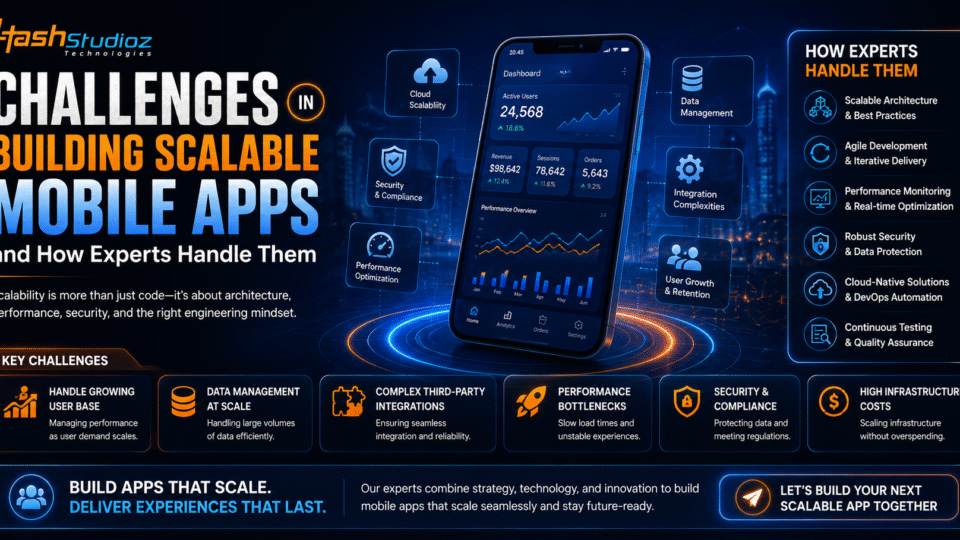
Key Challenges in Scalable Mobile App Development
The modern mobile application landscape demands flawless execution under intense operational strain. According to data published by Ericsson, global mobile subscriptions have surpassed 8.9 billion, driving the global mobile application market size toward an estimated $378 billion. Concurrently, a Sensor Tower analysis reveals that global consumers logged over 5.3 trillion hours inside mobile applications within a single year.
For engineering teams, these milestones present a complex technical reality. An application that operates smoothly with 1,000 users can completely break when traffic surges to 100,000 concurrent sessions. True scalability requires an application to handle exponential user growth, volatile network conditions, and massive data influxes without a degradation in speed or stability.
Achieving this standard requires highly specialized engineering expertise. Organizations frequently collaborate with an experienced Android app development company or leverage comprehensive Android app development services to build architectures capable of surviving these demands. This article explores the primary architectural, data, and device-level bottlenecks that disrupt mobile scaling, along with the concrete strategies that enterprise engineers implement to overcome them.
Architectural Bottlenecks and Structural Scalability
Monolithic software design is the primary enemy of mobile application scale. When developers build an application as a single, tightly coupled codebase, a failure in a single feature—such as a payment-processing loop or a chat synchronization service—can cause the entire application to crash. Furthermore, monolithic architectures force entire engineering departments to commit code to the same repository, creating merge conflicts, breaking continuous integration (CI) pipelines, and slowing down production deployments.
Transitioning to Clean Architecture and Micro-Frontends
Enterprise mobile engineers eliminate tightly coupled dependencies by applying Clean Architecture principles. Clean Architecture enforces a strict separation of concerns by splitting the codebase into independent structural layers:
- Data Layer: Manages raw network data sources, API clients, and local persistence.
- Domain Layer: Contains the core business logic, use cases, and entities completely isolated from the user interface.
- Presentation Layer: Executes the UI logic and handles state management routines using patterns like MVVM (Model-View-ViewModel) or MVI (Model-View-Intent).
By keeping the business logic independent of the UI and data frameworks, engineers can rewrite or scale individual components without breaking the rest of the ecosystem.
For large enterprise applications, organizations take this separation further by adopting micro-frontends or modular feature architectures. Under this model, developers package features—such as user onboarding, product search, and checkout modules—into distinct, self-contained binaries or dependency modules.
This modularity allows isolated teams to deploy updates independently, reduces overall compilation times, and ensures that an error within a secondary feature does not cause a crash across the entire application runtime.
Data Management and State Synchronization Challenges
As an application scales, managing data state across thousands of concurrent devices becomes exceptionally difficult. Unoptimized applications often flood backend infrastructure with duplicate, redundant API requests. This inefficient communication path rapidly drains server bandwidth, triggers rate limits, and degrades the client-side user experience, particularly over unstable or high-latency cellular networks.
Implementing Intelligent Local Caching and State Engines
To mitigate backend strain, expert developers transform the mobile client into an autonomous local data engine. Instead of forcing the user interface to query the network directly for every view state, the application communicates with an offline-first data layer.
- Declarative State Machines: Developers use unidirectional data flow (UDF) frameworks like Kotlin Flows, RxJava, or Swift Combine to manage UI states. The UI acts as a passive consumer that renders a single, unchangeable state object emitted by the business engine.
- Offline-First Storage: Engineers utilize embedded transactional engines like SQLite databases via Room or Core Data. When a user opens a screen, the application displays the locally cached records instantly, cutting screen loading latency down to milliseconds.
- Optimistic UI Updates: To ensure the user interface remains responsive on weak connections, applications modify local states instantly before receiving confirmation from the server. If the backend network call fails after multiple automated retries, the app gracefully rolls back the UI state and alerts the user.
Device Fragmentation and Resource Optimization
The global mobile ecosystem is highly fragmented. This issue is particularly visible in Android ecosystems, where applications run across thousands of unique device configurations with varying screen dimensions, processors, and system memory allocations.
An unoptimized application that runs perfectly on a premium flagship device can trigger severe memory leaks, drop frame rates, or crash due to Out-Of-Memory (OOM) exceptions on mid-to-low-tier hardware.
Managing Hardware Strain and Memory Footprints
Mobile experts implement strict client-side resource controls to prevent hardware exhaustion:
- Memory Leaks: Engineers deploy monitoring suites like LeakCanary during development cycles to catch lingering object references. They pay close attention to structural issues like background threads holding long-term references to UI contexts, which prevents the system’s garbage collector from reclaiming memory.
- Main Thread Isolation: The primary application execution thread must remain dedicated exclusively to rendering the interface. Developers offload database queries, network calculations, and heavy file I/O operations to background threads using asynchronous patterns like Kotlin Coroutines or Grand Central Dispatch (GCD). This isolation prevents the system from triggering Application Not Responding (ANR) dialogs.
- Asset Compression: Images and media files represent the largest components of an application’s network usage and runtime memory footprint. Teams replace legacy PNG and JPEG files with modern WebP formats or vector graphics. They also implement dynamic image loading libraries like Glide, Coil, or Kingfisher to resize assets programmatically based on the precise hardware display requirements of the target device.
Real-World Enterprise Scalability Case Study
To understand these concepts in a live enterprise scenario, consider the engineering overhaul of a global logistics and supply chain application used by field delivery personnel.
The Problem
The legacy application relied on direct, synchronous REST API calls to transmit delivery updates back to a central cloud database. During peak afternoon delivery windows, over 15,000 drivers would concurrently upload forms, image attachments, and location data coordinates.
Because delivery routes frequently passed through low-signal areas, network requests lingered, stalled, and timed out. The server database locked up under the volume of concurrent open connections, which caused frequent app crashes and led to lost delivery records.
The Solution
The engineering team redesigned the application’s synchronization architecture using an offline-first data model:
- Local Room DB Injection: Developers decoupled the user interface from direct network calls by introducing a local Room database layer. The delivery application saved all user actions, forms, and signatures directly to local storage first, ensuring the user interface remained responsive even without internet access.
- Background Sync Syncing Engine: The engineering team moved all data synchronization routines to background tasks controlled by the Android WorkManager API. WorkManager was configured with system execution constraints, instructing it to transmit data only when the device detected an active internet connection.
- Transition to MQTT: Engineers replaced the legacy REST API protocol with MQTT, a lightweight, binary publish-subscribe messaging protocol. MQTT reduced network payload overhead by over 60%, allowing devices to transfer data over highly degraded cellular connections.
The Outcome
This architectural rewrite eliminated data loss from dropped connections. The local UI remained perfectly responsive, eliminating client-side freezes. By replacing heavy REST payloads with lightweight MQTT packets and shifting to asynchronous background synchronization, the team reduced peak server load by 75%, allowing the backend infrastructure to easily support future fleet growth.
Business Impact and Return on Investment (ROI)
Investing in high-grade application architecture and scalability engineering is a direct contributor to business performance and operational cost control. Performance optimization directly influences user retention, infrastructure overhead, and development velocity.
| Optimization Vector | Technical Metric | Business / ROI Impact |
| Architectural Modularization | 65% reduction in build and compilation times. | Speeds up feature time-to-market and lowers engineering hours. |
| Offline-First Data Layer | API request volume dropped by 55%. | Drastically reduces monthly cloud infrastructure and data egress costs. |
| Thread Isolation & Optimization | Application crash rates reduced below 0.1%. | Boosts retention metrics and protects digital brand reputation. |
Final Thoughts
Building a scalable mobile application requires a disciplined approach to software engineering. Teams must proactively replace monolithic structures with modular, layered architectures, handle state data with offline-first repositories, and aggressively optimize code to protect limited device hardware resources. Because the mobile ecosystem changes rapidly, scaling is a continuous process of refinement rather than a one-time project phase. For organizations building complex mobile ecosystems, partnering with a premier Android app development company that provides specialized, high-tier Android app development services ensures your code is built to handle explosive growth. By implementing these enterprise architectural standards, your application can easily scale from its initial user base to millions of concurrent global sessions.

Leave a Reply