


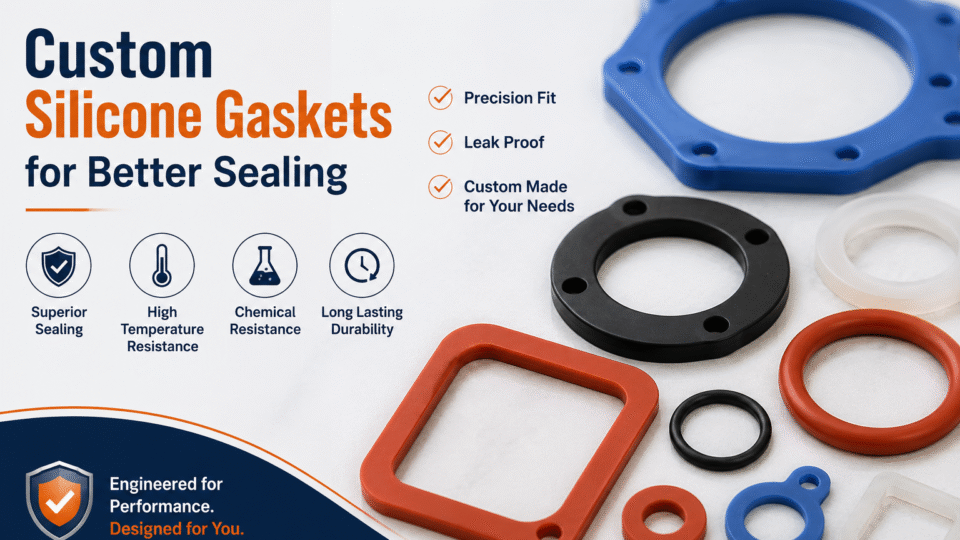
Custom Silicone Gaskets for Better Sealing
In precision equipment, sealing problems rarely announce themselves. They usually start small, with a gasket that looked fine on paper but never quite behaved the same once the machine was actually running on the shop floor.
Gaskets are usually not something people think much about during installation. Everyone focuses on motors, controls, automation, and output targets. The gasket just sits quietly in the background, listed on a drawing or BOM. In many systems, especially those using OEM rubber bellows or sealing assemblies, it’s treated as a secondary detail.
Until it starts failing.
You get leaks, pressure issues, product loss, and sometimes even contamination risks. The kind of problems that don’t look big on paper but are very expensive in real life.
That’s why more companies are slowly moving toward custom silicone gaskets instead of sticking only to standard ones.
Not because custom sounds better. Usually, because the standard ones stopped working the way they were supposed to.
The real issue is rarely the gasket itself
If you actually walk through plants, you realise something pretty quickly, the environment is rarely what the datasheet assumes.
On paper, everything looks fine. Temperature range matches, size fits, and material are “compatible.”
But machines don’t run on paper.
They run in heat cycles, vibration, cleaning chemicals, pressure changes, washdowns… and sometimes all of that in the same day.
A gasket that looked perfect during installation slowly starts behaving differently. It doesn’t fail immediately. It just becomes less reliable over time.
I’ve seen cases where engineers kept changing other parts of the system, chasing the problem, when the actual issue was just the sealing interface not being designed for the real conditions.
That’s usually the point where custom silicone gaskets start making sense.
Not as an upgrade. Just as something that finally matches reality.
In some equipment designs, especially where custom molded rubber bellows are also used for movement protection, sealing issues become even more noticeable when tolerances are tight.
Heat is usually where things start going wrong
Temperature issues are interesting because they don’t show up as a sudden failure most of the time.
A gasket doesn’t just break one morning.
It slowly loses its flexibility. Compression changes slightly. Nothing dramatic enough to trigger immediate attention.
Then maintenance intervals start getting shorter. Operators notice small inconsistencies. Maybe a machine doesn’t seal as cleanly as it used to.
Silicone tends to handle this better than many materials because it stays stable across a wider temperature range.
That’s why you see it in food processing equipment, sterilisation systems, packaging machines, anywhere heat cycles are constant. In some setups, engineers even pair it with a rubber bellows manufacturer solution when motion and heat need to be managed together.
It’s also why silicone bellows show up in similar environments, especially where movement and temperature both matter.
Still, it’s not magic. It just behaves more consistently when conditions are harsh.
Cleaning standards have changed the game
Anyone working in food or pharma will tell you hygiene requirements are getting stricter every few years.
What was acceptable earlier doesn’t always pass today.
That puts sealing components under pressure because they don’t just need to seal; they need to survive repeated cleaning without degrading.
Silicone does reasonably well here. It doesn’t get damaged easily by moisture or cleaning cycles, which is why it shows up so often in sanitary designs.
Funny thing is, even outside heavy industry, similar thinking exists.
Even something like custom butter molds goes through the same evaluation: can it be cleaned properly, does it last, does it hold shape over time? Different product, same material thinking.
In the same way, moulded rubber bellows used in hygienic or protected systems also follow similar design expectations for durability and cleanability.
Why custom designs keep increasing
Most modern machines aren’t really “standard” anymore.
Even two machines doing the same job in different factories often end up slightly different. Mounting, spacing, operating cycles, maintenance habits, all of it varies.
So when you use a standard gasket, you are basically hoping it fits a situation that keeps changing.
Sometimes it works. Sometimes it doesn’t.
That’s why custom designs are becoming more normal. Not because engineers like complexity, but because equipment has become less uniform.
The same logic applies in other components too. Anyone who has worked with a rubber bellows manufacturer knows this already; bellows are almost always application-specific because movement is never identical.
Molded rubber bellows follow the same idea. They are shaped around actual working conditions, not generic sizes.
Sealing is just another version of that same problem.
In many cases, custom butter molds are also customised for this exact reason—standard geometry rarely survives real operating variation for long.
Conclusion
Most people don’t switch to custom silicone gaskets because they want something advanced or special.
It usually happens after enough small failures add up to leaks, downtime, and maintenance calls that shouldn’t have been necessary.
At some point, it becomes clear that the issue isn’t the machine itself, but how the sealing was originally assumed rather than designed.
And once you start looking at real operating conditions instead of ideal ones, custom solutions stop feeling like an upgrade and start feeling normal.
Whether it’s working with a rubber bellows manufacturer, using moulded rubber bellows for motion control, relying on OEM rubber bellows, or applying silicone bellows in harsh environments, the idea stays the same:
Real-world conditions always win over catalogue assumptions.
FAQs
1. Why do custom silicone gaskets perform better?
Because they are made for actual machine conditions instead of general specifications.
2. Where are they commonly used?
Food, pharma, packaging, electronics, automation, and industrial machinery.
3. Do silicone gaskets handle heat well?
Yes, they stay stable across a wide temperature range, which is why they are widely used in thermal processes.
4. What is the role of silicone bellows?
They protect moving parts and handle movement while resisting dust, moisture, and temperature variation.
5. How are gaskets different from moulded rubber bellows?
Gaskets seal static joints, while bellows handle movement and protection of mechanical parts.
CTA
If your equipment keeps showing small but repeated sealing issues, it’s usually worth looking beyond standard parts. A properly designed custom silicone gasket often solves problems that look complicated on the surface but come down to fit and environmental mismatch.



Leave a Reply