


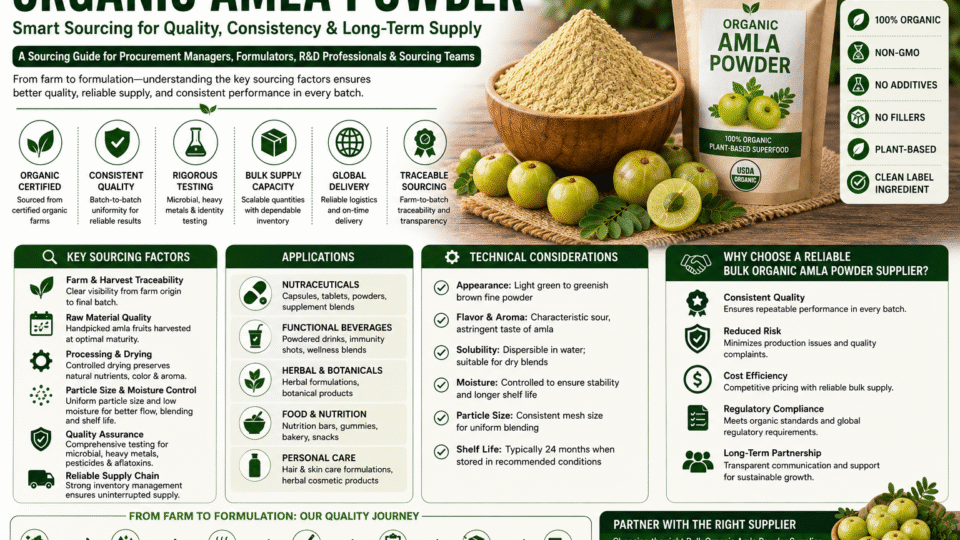
Sourcing Considerations for Organic Amla Powder
As botanical ingredients continue to gain traction across the US nutraceutical, functional beverage, and food industries, procurement teams are expected to secure ingredients that support both formulation performance and long-term supply continuity. While certifications and pricing remain part of the evaluation process, they are no longer the primary factors influencing supplier selection.
Organic Amla Powder is a clear example of this shift. In many sourcing projects, we see procurement teams comparing multiple suppliers whose documentation appears nearly identical. However, once production begins, differences in moisture levels, particle size, processing methods, and raw material quality often become evident. These variations can affect blending efficiency, manufacturing consistency, and inventory management, making supplier evaluation far more technical than reviewing specification sheets.
For procurement managers, formulators, and R&D professionals, understanding these sourcing realities helps reduce operational risk while improving production reliability.
Understanding Organic Amla Powder in Industrial Applications
Organic Amla Powder is manufactured from organically cultivated Indian gooseberries (Phyllanthus emblica). The fruit is harvested at optimum maturity, washed, sliced, dried under controlled conditions, and milled into a fine powder suitable for commercial food, nutraceutical, and beverage manufacturing.
Most commercial production originates in India, where established cultivation regions support large-scale organic farming. However, regional climate, harvest timing, drying methods, and milling technology can all influence the finished ingredient’s appearance and processing characteristics.
Manufacturers commonly select Organic Amla Powder because it offers:
- Easy incorporation into powdered formulations
- Good compatibility with botanical ingredient systems
- Clean-label and plant-based positioning
- Efficient storage and transportation
- Flexible use across supplements, beverages, and functional foods
These operational advantages continue to increase demand among manufacturers looking for a dependable Bulk Organic Amla Powder Supplier.
Supplier Evaluation Goes Beyond Documentation
One observation we frequently encounter is that complete documentation does not always guarantee manufacturing consistency. While procurement teams should always verify Organic certification, Certificates of Analysis (COAs), microbiological reports, heavy metal testing, allergen statements, and MSDS documentation, experienced buyers typically investigate several additional factors before approving a supplier.
These include:
- Farm and harvest traceability
- Fruit maturity at harvest
- Drying and milling technology
- Moisture control practices
- Particle size consistency
- Batch-to-batch uniformity
- Packaging standards
- Warehouse and inventory management
These production-related characteristics often have a greater influence on manufacturing performance than analytical values alone.
Technical Considerations for Formulators
From a formulation perspective, Organic Amla Powder performs well across many dry applications, provided the raw material remains consistent between production lots.
Nutraceutical Manufacturing
Organic Amla Powder is widely used in:
- Capsules
- Tablets
- Botanical blends
- Powdered supplements
- Stick packs and sachets
Formulators commonly evaluate:
- Powder flowability
- Moisture stability
- Uniform particle size
- Blend consistency
- Dust generation
- Shelf-life performance
Maintaining these physical characteristics contributes to efficient processing and repeatable production outcomes.
Functional Food and Beverage Systems
Food and beverage manufacturers also incorporate Organic Amla Powder into powdered drink mixes, nutrition bars, fruit blends, bakery products, and plant-based formulations.
One issue we often observe during supplier comparisons is inconsistency in natural color, aroma, and powder texture. These differences are frequently linked to drying temperatures and post-harvest handling rather than laboratory specifications, making production trials an important part of supplier qualification.
Bulk Procurement Challenges
As demand for botanical ingredients continues to grow, sourcing Organic Amla Powder at commercial volumes presents several practical challenges.
Seasonal harvest conditions can affect raw material availability, while different processing facilities may produce noticeable variation in particle size and moisture levels. Supply continuity can also become a concern during periods of increased export demand.
To reduce procurement risk, experienced sourcing teams commonly request:
- Farm-to-batch traceability
- Organic certification validation
- Identity verification reports
- Moisture specifications
- Particle size analysis
- Batch retention samples
- Packaging verification
- Long-term supply planning
These operational indicators often provide greater confidence than pricing alone when selecting a Bulk Organic Amla Powder Supplier.
Market Trends Supporting Demand
Demand for Organic Amla Powder continues to expand throughout the United States as manufacturers develop botanical supplements, plant-based nutrition products, powdered beverages, and clean-label food formulations.
Emerging applications include:
- Botanical nutrition blends
- Functional beverage powders
- Plant-based wellness products
- Fruit-based supplement formulations
- Multi-ingredient botanical products
- Powdered functional foods
As these product categories continue to grow, procurement teams increasingly prioritize suppliers capable of delivering consistent quality, transparent sourcing practices, and dependable year-round inventory.
Conclusion
For procurement managers, formulators, and sourcing professionals, selecting Organic Amla Powder involves much more than comparing prices or reviewing laboratory reports.
Harvest maturity, cultivation practices, drying technology, moisture management, particle consistency, traceability, and supply chain reliability all contribute to manufacturing success. In many commercial sourcing environments, suppliers that consistently deliver repeatable quality and dependable operational support become strategic partners rather than transactional vendors.
As demand continues to increase, working with a qualified Bulk Organic Amla Powder Supplier and adopting a comprehensive supplier evaluation process can help manufacturers improve formulation consistency, strengthen production planning, and build a more resilient supply chain.

Leave a Reply