


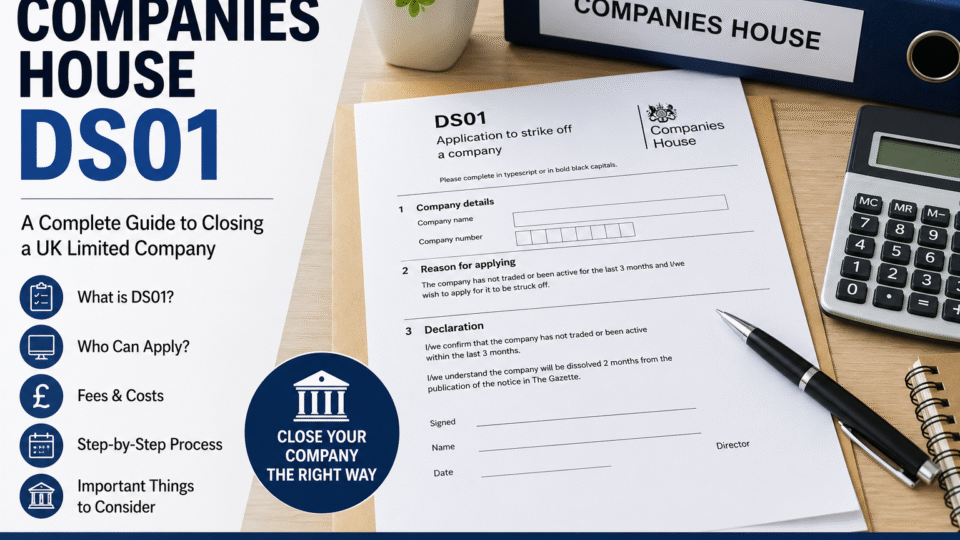
Companies House DS01: A Simple UK Closure Guide
Closing a limited company is an important decision that should be handled carefully. Whether a business has stopped trading, the directors no longer need the company, or the original business plan has changed, there are several responsibilities to complete before the company can be removed from the Companies House register.
For eligible businesses, voluntary strike-off can be a relatively straightforward way to close a company. The process is commonly associated with the Companies House DS01 application, which is used to request that a limited company be struck off the register. Understanding the form DS01, the eligibility requirements, the information required, and what happens after the application can help directors avoid unnecessary delays or complications. This guide explains what UK business owners and company directors should know before applying for voluntary strike-off.
What Is the Companies House DS01?
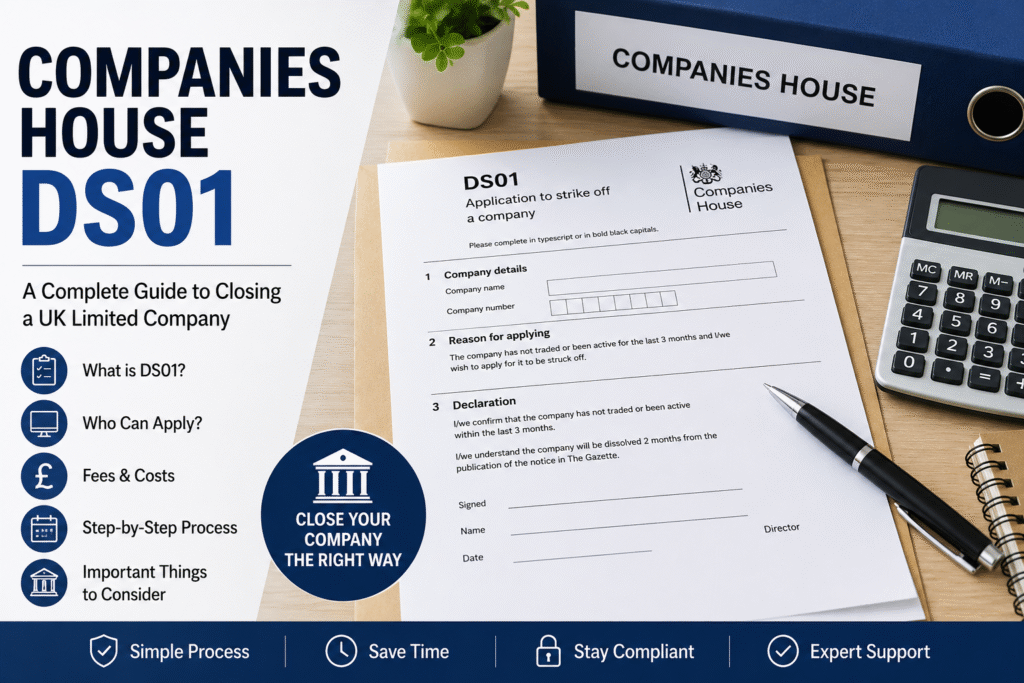
The Companies House DS01 is the application used to request that a limited company be struck off the Companies House register.
Strike-off is also commonly referred to as voluntary dissolution. If the application is successful and nobody successfully objects, the company is removed from the register and legally ceases to exist.
Companies House provides an online service for closing eligible companies. The online process is designed to make applications easier and includes checks to help applicants complete the application correctly.
A paper version of the DS01 remains available for situations where the company cannot apply online. Companies House recommends using the online service where possible because paper applications generally take longer to process.
Why Would a Company Use Form DS01?
There are many reasons why directors may decide to close a limited company. A company may:
- Have stopped trading
- No longer be commercially useful
- Have completed the purpose for which it was established
- Be replaced by another business
- Have become inactive
- No longer have customers or contracts
- Be costing more to maintain than it is worth
- Be part of a restructuring decision
If the company is eligible for voluntary strike-off, submitting a DS01 application can provide a simpler alternative to a formal liquidation process.
However, directors should not assume that every inactive company can automatically be dissolved. The company must meet the relevant conditions and deal properly with its remaining financial and administrative responsibilities.
Who Can Apply Using the Companies House DS01?
Voluntary strike-off is intended for companies that meet specific conditions.
Generally, a company should not have:
- Traded or carried on business during the previous three months
- Changed its company name during the previous three months
- Been threatened with liquidation
- Entered into certain arrangements with creditors
The purpose of these requirements is to make sure that voluntary strike-off is being used appropriately.
A company should not use the process to avoid paying creditors or dealing with financial difficulties. If a business cannot pay its debts, directors should consider whether an insolvency procedure is more appropriate.
What Is Form DS01?
The form DS01 is the paper version of the strike-off application.
The form contains information that Companies House needs to process the company’s voluntary strike-off request. This includes the company’s name and company number, along with information relating to the directors and authentication of the application.
The current paper DS01 form also contains a checklist reminding applicants to make sure the company details match the Companies House register and that the correct number of directors have authenticated and dated the application.
Companies House recommends using its online service where possible rather than sending the paper form by post.
Online DS01 vs Paper Form DS01
There are two main ways an eligible company can apply for voluntary strike-off.
Online Application
The online route is generally the preferred option. The current online application fee is £13, and payment can be made using a debit or credit card. The online service also includes checks designed to help applicants complete the application correctly.
Paper DS01
The paper form DS01 can be used when the company cannot apply online. The current paper application fee is £18, and Companies House states that paper applications usually take longer to process.
Therefore, directors who are able to use the online service will generally find it more convenient.
What Should You Do Before Submitting DS01?
Submitting the DS01 should not be the first thing a director does when closing a company. Before applying, the company’s affairs should be reviewed carefully.
1. Stop Trading
The company must satisfy the relevant conditions for voluntary strike-off. If it has traded recently, directors should check when the company last carried on business and whether the required period has passed.
Applying too early can result in the application being rejected or challenged.
2. Deal With Company Assets
Any assets owned by the company should be dealt with before dissolution. These may include:
- Money in the business bank account
- Equipment
- Vehicles
- Stock
- Property
- Domain names
- Intellectual property
- Refunds
- Investments
- Other company-owned assets
This is particularly important because assets remaining after dissolution can pass to the Crown. Companies House warns that remaining bank balances and other assets can pass to the Crown after the company is dissolved.
3. Deal With Outstanding Debts
Directors should review the company’s liabilities before applying. Outstanding amounts may include:
- Supplier invoices
- Loans
- Credit cards
- Employee payments
- Professional fees
- Tax liabilities
- Other creditor balances
Voluntary strike-off should not be treated as a way of avoiding legitimate debts. Creditors can object to a company’s proposed strike-off, potentially preventing the company from being dissolved.
4. Complete Tax Responsibilities
Closing a company does not automatically remove its tax obligations. Directors should make sure the company deals with its final tax position appropriately.
This may include Corporation Tax, VAT, PAYE, and other relevant obligations depending on the company’s circumstances.
Final accounts and tax information may need to be submitted before the company is fully closed. Professional accounting advice can be particularly useful if the company has complicated tax affairs or significant assets.
Who Needs to Sign the DS01?
The form DS01 must be authenticated by the required number of directors.
If a company has one director, that director must authenticate the application. If it has two directors, both must do so. Where there are more than two directors, a majority must authenticate the application.
This requirement is important because an incorrectly completed application can be returned or delayed. Directors should therefore check the company’s current information on the Companies House register before completing the application.
How Much Does the Companies House DS01 Cost?
The cost depends on how the application is submitted.
- Online application: £13
- Paper DS01 application: £18
Companies House updated these fees on 1 February 2026. The online option is therefore both cheaper and generally faster than the paper route.
What Happens After Submitting DS01?
Submitting the application does not immediately dissolve the company. Companies House first reviews the application.
If the application is correctly completed and accepted, a notice of the proposed strike-off is published in The Gazette. The notice gives interested parties an opportunity to object.
If no successful objection is made, the company can eventually be struck off the register. Companies House states that the company will be struck off once the two-month period mentioned in the Gazette notice has passed, provided there is no successful objection.
This means directors should continue monitoring the company’s correspondence after submitting the application.
Can Someone Object to a DS01 Application?
Yes. Creditors and other interested parties can object to a company’s proposed strike-off.
An objection might be made if:
- The company still owes money
- The company is still trading
- The company has not dealt with its tax obligations
- Legal proceedings are ongoing
- The company has assets that have not been dealt with
- The company does not meet the strike-off conditions
Directors should therefore make sure that the company’s affairs are properly dealt with before submitting DS01.
What Happens to the Company Bank Account?
One of the most important things to consider is the company’s bank account.
Companies House guidance states that the company’s bank account will be frozen from the date of dissolution. Any credit balance remaining in the account can pass to the Crown.
For this reason, directors should not leave company funds in the bank account when the company is dissolved. The same principle applies to other company assets.
If assets are discovered after dissolution, restoring the company may be necessary to recover or deal with them.
Does DS01 Cancel Company Debts?
No. Submitting the Companies House DS01 application does not automatically cancel legitimate debts.
If the company has outstanding creditors, they may object to the strike-off. More importantly, directors should understand that voluntary strike-off is not designed to replace formal insolvency procedures.
If a company is unable to pay its debts, professional insolvency advice may be required. Using strike-off to avoid creditors can result in serious consequences.
What Happens to Employees?
If the company employs staff, directors need to deal with employment responsibilities before closing the company.
This may include:
- Final salary payments
- Holiday pay
- Redundancy obligations
- PAYE responsibilities
- Employee records
- Pension responsibilities
A company should not simply submit DS01 while ignoring its employee obligations. The exact requirements will depend on the company’s circumstances, so professional advice may be appropriate where employees are involved.
What Records Should Be Kept After Dissolution?
Dissolution does not mean that all company records should immediately be discarded. Companies House guidance states that certain records need to be retained after a company is struck off. Some business documents may need to be kept for several years, while specific employment-related records have their own requirements. Maintaining appropriate records can help if questions arise after the company has been dissolved. Directors should therefore establish which documents need to be retained before disposing of business records.
Common Mistakes When Completing Form DS01
Mistake 1: Applying Before the Company Is Eligible
A company that has traded within the relevant period may not qualify for voluntary strike-off. Always check the eligibility conditions before applying.
Mistake 2: Leaving Assets Behind
Bank balances, equipment, refunds, and other assets can create complications after dissolution. Deal with assets before the company disappears from the register.
Mistake 3: Forgetting Tax
The company’s final tax responsibilities should be addressed before dissolution. Do not assume that submitting DS01 automatically closes the company’s tax affairs.
Mistake 4: Ignoring Creditors
Outstanding creditors can object to the strike-off. Make sure legitimate liabilities are properly addressed.
Mistake 5: Incorrect Director Authentication
The correct number of directors must authenticate and date the application. Errors here can delay the process.
Mistake 6: Assuming Dissolution Is Immediate
The company does not disappear immediately after DS01 is submitted. There is a notice and objection period before the final dissolution takes place.
When Should You Speak to an Accountant?
Some straightforward companies may be able to complete the strike-off process without extensive professional assistance. However, speaking to an accountant can be useful when the company has:
- Significant cash reserves
- Business assets
- Outstanding tax
- VAT registration
- Employees
- Loans
- Shareholder complications
- Property
- Uncertain financial status
- Outstanding debts
An accountant can help review the company’s financial position before the DS01 application is submitted. This can reduce the risk of discovering important issues after the company has already been dissolved.
Is DS01 the Same as Company Dissolution?
DS01 is the application to begin the voluntary strike-off process. The company is not legally dissolved simply because the DS01 application has been submitted.
The process normally involves:
DS01 application → Companies House review → Gazette notice → objection period → strike-off → final Gazette notice
Once the final dissolution takes place, the company no longer legally exists. This distinction is important because directors continue to have responsibilities during the strike-off process.
Final Thoughts
The Companies House DS01 process provides eligible UK limited companies with a practical way to apply for voluntary strike-off.
However, directors should not view DS01 as simply a form that needs to be completed and submitted. The company should first stop trading, deal with its assets and liabilities, address tax responsibilities, manage employee obligations, and make sure it meets the eligibility requirements.
The form DS01 can be submitted online or by paper where appropriate. The online route currently costs £13, while the paper application costs £18 and is generally slower to process.
Once the application is accepted, Companies House publishes a notice in The Gazette. If nobody successfully objects during the relevant period, the company can be struck off and legally dissolved.
For companies with straightforward affairs, the process can be relatively simple. However, businesses with debts, assets, employees, tax issues, or other complications should consider obtaining professional advice before applying.
Taking the time to prepare properly can help directors avoid unnecessary delays, protect company assets, and close the business in a more organised and compliant way.
Frequently Asked Questions
1. What is the Companies House DS01 form?
The DS01 is the application used by a limited company to request voluntary strike-off from the Companies House register.
2. Can I submit the DS01 online?
Yes. Companies House provides an online service for eligible companies. The current online application fee is £13.
3. How much does the form DS01 cost?
The current online fee is £13. A paper DS01 application costs £18.
4. How many directors need to sign DS01?
The required number depends on the number of current directors. One director must authenticate if there is one director, both if there are two, and a majority if there are more than two.
5. Does submitting DS01 immediately close a company?
No. Companies House first reviews the application and publishes a Gazette notice. If there is no successful objection, the company can subsequently be dissolved.
6. Can a creditor object to a DS01 application?
Yes. Creditors and other interested parties can object if they have valid grounds and supporting evidence.
7. What happens to money left in a company bank account?
After dissolution, remaining assets, including certain bank balances, can pass to the Crown. Directors should deal with company assets before dissolution.
8. Can a company with debts use DS01?
Directors should be particularly careful if the company has outstanding debts. Voluntary strike-off should not be used as a substitute for formal insolvency proceedings.

Leave a Reply