


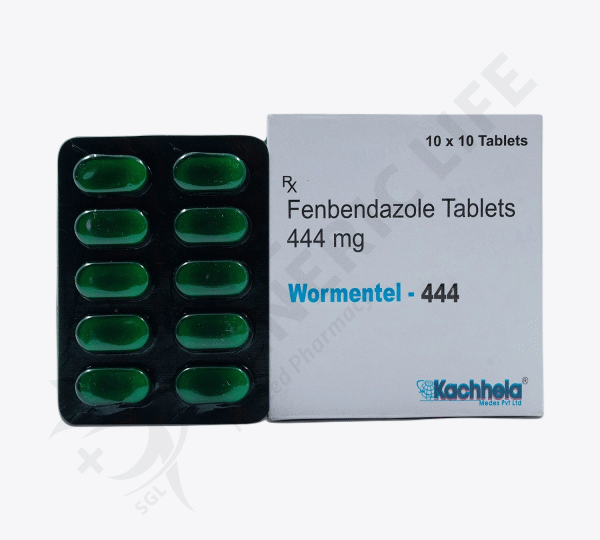
Fenbendazole 444: A Stronge Dewormer or Sounds Powerful
The short answer is that the number attached to a fenbendazole product should never be treated as a shortcut for deciding how much an animal needs. Fenbendazole is a veterinary anthelmintic, meaning it is used to control certain parasitic worms in animals. It has been used in veterinary medicine for decades, with approved products available for species including dogs, horses, cattle, and goats. However, the concentration, formulation, target animal, approved indication, and treatment schedule can differ considerably from one product to another. The U.S. Food and Drug Administration (FDA), for example, lists multiple approved fenbendazole products and formulations.
That distinction matters when someone searches for Fenbendazole 444 online. A product name or number by itself does not establish that the product is an officially recognized strength or that it is appropriate for a particular animal. Veterinary medicines are normally selected according to the animal’s species, body weight, parasite, formulation, and the directions associated with the specific product. Treating the number on a package as though it were automatically equivalent to a dose can lead to mistakes.
What Is Fenbendazole Actually Used For?
Fenbendazole belongs to the benzimidazole class of deworming medicines. Its primary veterinary role is parasite control rather than general wellness. Depending on the animal and approved product, it can be used against particular gastrointestinal or respiratory worms. For example, FDA-approved fenbendazole products are labeled for specific parasites in dogs, horses, cattle, and goats. The exact list varies by species and formulation, which is one reason broad claims such as “fenbendazole kills every worm” are misleading.
In dogs, for instance, FDA information states that fenbendazole is approved for the treatment and control of certain ascarids, hookworms, whipworms, and tapeworms, with a labeled regimen of 50 mg/kg for three consecutive days for the indications described. That does not mean the same regimen should automatically be transferred to another species or another fenbendazole formulation. Veterinary treatment is more specific than simply matching a product name with a parasite.
This is where Fenbendazole 444 becomes an interesting search topic. People may assume that a larger number means a stronger or more effective dewormer, but strength and dose are not interchangeable concepts. A concentration tells you how much active ingredient is present in a particular amount of a formulation. The amount an animal should receive depends on the labeled product and the animal being treated.
Why the “444” Number Deserves a Closer Look
The most useful question to ask about Fenbendazole 444 is not “Is 444 powerful?” but “What exactly does 444 refer to?”
If an online listing uses “444” as part of its product name, consumers should look for the actual active-ingredient concentration, dosage form, manufacturer, intended species, registration or approval information where applicable, and complete labeling. Without those details, the number alone provides very little useful clinical information.
This is particularly important because legitimate fenbendazole products come in different formulations. One current FDA-listed cattle and horse product, for example, is a 10% suspension containing 100 mg of fenbendazole per mL. Another approved canine product is a 22.2% granule formulation. These are not interchangeable simply because both contain fenbendazole.
So, if a product marketed as Fenbendazole 444 does not clearly explain what the number represents, that uncertainty should be treated as a reason to investigate rather than a reason to assume the product is stronger.
The Real Question: Which Parasite Is Being Treated?
Another often-overlooked issue is diagnosis. A pet may show diarrhea, weight loss, poor appetite, coughing, changes in stool, or other symptoms for many different reasons. Not every digestive problem is caused by worms, and not every parasite responds to fenbendazole.
That makes fecal testing and veterinary assessment valuable tools. Official product information also emphasizes diagnostic testing and monitoring when appropriate. For livestock products, FDA labeling warns that parasite resistance can develop and recommends fecal examinations or other diagnostic approaches as part of parasite-management decisions.
A more sensible approach is therefore to identify the suspected parasite first and then determine whether fenbendazole is an appropriate treatment. This avoids the common assumption that a dewormer should be given simply because an animal appears unwell.
Is a Higher Strength Automatically Better?
Not necessarily—and this is one of the most important points surrounding Fenbendazole 444.
Veterinary medicine does not work on the principle that a larger number automatically produces a better result. The objective is to use an appropriate medicine at an appropriate dose for an appropriate period. Increasing the amount or extending treatment without veterinary guidance can introduce unnecessary risk.
The FDA has specifically warned veterinarians about adverse events associated with extra-label fenbendazole use in dogs. As of October 2023, the agency had received 12 reports of bone marrow hypoplasia or pancytopenia associated with treatment longer than the labeled three-day duration. The reported treatment periods ranged from five to 14 days. FDA stated that fenbendazole is considered safe and effective when used according to labeled dose, duration, and indications, while highlighting concerns about prolonged extra-label use.
That information changes the way a “high-strength” product should be viewed. More is not automatically better, and longer is not automatically more effective.
What About Fenbendazole and Non-Veterinary Health Claims?
Fenbendazole has also attracted attention online because of claims that extend far beyond conventional parasite treatment. Some discussions have promoted it for purposes unrelated to its established veterinary indications, including various human health and cancer-related claims.
Those claims should be separated from the medicine’s established veterinary role. Approved animal-drug labeling is based on particular species, conditions, formulations, doses, and safety data. It does not establish fenbendazole as a general-purpose human medicine. Current veterinary product labeling explicitly states that certain fenbendazole animal products are not for use in humans.
For website readers, this distinction is especially important because online discussions can blur the line between laboratory research, anecdotal reports, experimental ideas, and established medical evidence. A compelling story is not the same thing as a proven treatment.
What Should Buyers Check Before Considering Fenbendazole 444?
Rather than focusing on the number “444,” look at the information that actually determines whether a veterinary product is appropriate:
- Active ingredient and concentration: Confirm exactly how much fenbendazole the formulation contains.
- Target species: A product labeled for cattle or horses should not automatically be assumed suitable for dogs, cats, or other animals.
- Approved indications: Check which parasites and conditions the product is actually intended to treat.
- Manufacturer and labeling: Reliable products should provide clear product information rather than relying on a vague strength number.
- Veterinary guidance: When the diagnosis, species, dosage, or treatment duration is uncertain, a veterinarian is the appropriate source of advice.
For food-producing animals, withdrawal periods are another major consideration. Current FDA information for certain fenbendazole cattle and goat products includes specific meat and milk restrictions after treatment. Those periods vary according to the product and species, so they should never be guessed from the name or strength printed on a package.
The Bottom Line on Fenbendazole 444
The growing interest in Fenbendazole 444 illustrates a broader problem with online veterinary-product searches: numbers can look authoritative even when they provide little context. A higher-looking figure does not automatically mean a stronger, safer, or more effective treatment.
Fenbendazole itself is a well-established veterinary deworming ingredient with approved uses in several animal species. But its proper use depends on the specific product, parasite, species, dose, and treatment duration. Current FDA information also makes clear that prolonged or extra-label use can carry risks, particularly when treatment goes beyond established directions.
So, is Fenbendazole 444 a breakthrough high-strength dewormer? That conclusion cannot be drawn from the number alone. The more useful question is what the product actually contains, who it is designed for, what it is approved to treat, and whether there is a confirmed reason to use it. For pet owners and livestock keepers, those details are far more meaningful than an eye-catching number on a product listing.
Ultimately, responsible parasite control is less about finding the “strongest” dewormer and more about finding the right dewormer for the animal and the parasite involved. That may not be as sensational as the latest online claim, but it is a much safer and more evidence-based way to approach veterinary treatment.
For More Information visit here: Safegenericlife






Leave a Reply