


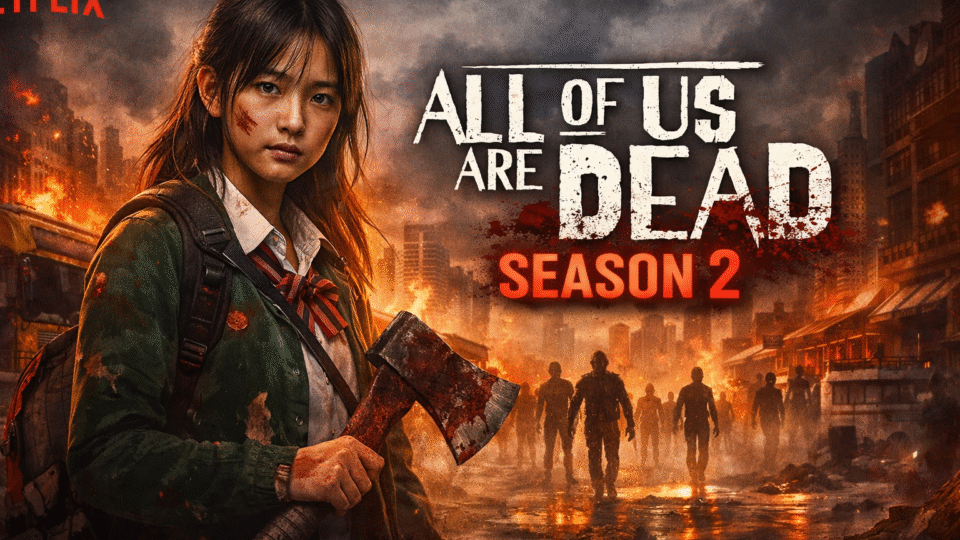
All of Us Are Dead Season 2 — full guide, expectations, and why fans can’t stop talking about it
When Netflix’s high-school zombie thriller All of Us Are Dead hit screens in 2022, it quickly joined the rare club of K-dramas that became global pop-culture watercooler topics. It married the claustrophobic terror of a contained outbreak with raw teenage melodrama, social commentary, and a handful of iconic character moments. Now, after long fan anticipation and a time jump in the narrative, Season 2 is officially in production — and the series looks set to evolve from schoolyard survival horror into something broader, harder-edged, and emotionally complex.
Why Season 1 mattered: quick recap and the cliffhanger that set up Season 2

All of Us Are Dead Season 1 placed Hyosan High at the center of a viral outbreak that turns students and faculty into ravenous zombies. The show balanced gut-punch gore with adolescent drama — bullies, love triangles, and the pressure-cooker world of Korean high school exams — and it did so while asking a darker question: who do societies sacrifice when disaster arrives?
By the end of Season 1 the show had introduced evolved, faster, and more terrifying forms of infected (often called “hambies” in fan lexicon) and left the central characters emotionally shattered. The finale’s time jump and unresolved fates left doors open — for new outbreaks, for survivors rebuilding their lives, and for government or scientific responses to the virus. Those loose ends are the springboard for Season 2.
Where Season 2 picks up (what we know so far)

Official updates from Netflix/Tudum and other coverage indicate Season 2 will begin after a time jump: Nam On-jo (Park Ji-hu) is now studying at university in Seoul and still carrying the trauma of the Hyosan outbreak. The new season reportedly expands beyond the high-school bubble to university life and the wider city, where a new outbreak threatens to undo any fragile normalcy. Producers have signaled a mix of returning faces and new characters — and an interest in deepening the show’s investigation into how institutions respond when systems fail.
A key production milestone: Netflix confirmed that Season 2 moved into production with the main cast doing initial readings and filming activity reported in mid-2025, putting the project squarely back on Netflix’s schedule after a multi-year wait. That said, exact release dates remain unconfirmed and many outlets note a realistic timeline likely extends into late 2025 or 2026, depending on post-production and international scheduling.
Cast and characters — who’s coming back, who’s missing
Early production notes and reporting confirm that several central cast members — including Park Ji-hu (On-jo), Yoon Chan-young (Cheong-san), Lomon (Su-hyeok), and Cho Yi-hyun (Nam-ra) — are expected to reprise their roles, which will preserve continuity and anchor the series emotionally. At the same time, casting shifts have fans talking: a few actors (reported in some outlets) will not return, and new faces — university students, government figures, and potentially scientists — are being introduced to broaden the story’s scope. Expect a tonal shift as the setting expands from one school to a whole city and campus.
How writers can take the show forward — big narrative possibilities
Season 1 made its moral points by placing teenagers in impossible situations; Season 2 can pivot those emotional stakes into new narrative territory:
- Trauma and reintegration: On-jo and others surviving the Hyosan incident must navigate life post-apocalypse — therapy, guilt, survivor’s stigma, and attempts to reclaim youth. This gives the show room for quieter character work in between scares.

- Institutional failure & accountability: Season 1 already hinted at systemic collapse (cover-ups, failed administrations). Season 2 can escalate this into political consequences, investigations, or even a darker exploration of how bureaucracies weaponize or mismanage outbreaks.

- Evolved infected & scientific mystery: The show teased faster, smarter variants. Season 2 can make the virus itself a central antagonist — forcing characters to adapt, test limits, and confront ethical questions about experiments and containment.
- Scale & new survival modes: Moving to university and city settings allows different survival scenarios (crowd panic, mass transit breakdowns, urban siegecraft), which can produce fresh suspense mechanics beyond the locked-school formula.
These narrative avenues let the writers preserve what worked — intimate character dilemmas and visceral horror — while raising the stakes in different, smarter ways.
What viewers liked (and complained about) in Season 1 — lessons Season 2 should learn
Across critic and viewer reviews, certain consistent patterns appear:
- Praise: High marks for character empathy (the show makes you care about even minor characters), production value, and the successful blending of melodrama with horror. Critics noted the emotional beats often land harder than the gore, making the series feel human even amid carnage.
- Criticism: A frequent critique was pacing. Many reviewers felt 12 episodes sometimes stretched scenes longer than necessary — an “overlong season” complaint that suggested editing could tighten in Season 2. Some viewers also felt certain narrative choices (underused immunes, unexplained motivations) left potential unfulfilled.
Takeaway for Season 2: Keep the deep character work and high production values, but tighten narrative focus — make every episode pull its weight, and ensure character arcs have payoff.
Fan culture & online reaction — what people are saying

Fans remain vocal on social media and forums. There are passionate “ships” (On-jo/Cheong-san), threads grieving favorite character deaths, meme culture around specific scenes, and debate about the show’s social commentary. Importantly, fandom has been both the engine behind the show’s long-term visibility and a feedback loop for Netflix — online chatter has kept Season 2 firmly on the company’s radar. Expect fan theories to shape early conversations around Season 2 releases and trailers.
Will Season 2 be bigger? Budget, spectacle, and Netflix’s international push

Netflix has increasingly leaned into global tentpoles that can cross borders, and All of Us Are Dead fits that agenda: a show with proven international traction can justify a bigger budget, wider cast, and more ambitious sequences. Reports suggest Season 2’s production is aiming for scale — more locations, larger crowd scenes, and higher-stakes set pieces — while keeping the emotional core intact. If Netflix wants this to be a long-running franchise, Season 2 is the moment to prove it can grow without losing identity.
FAQs
Yes — Netflix announced Season 2, and production began with cast table reads in mid–2025; official reporting shows filming in progress, though a final release date has not been confirmed.
Key Season 1 cast members such as Park Ji-hu (Nam On-jo), Yoon Chan-young (Lee Cheong-san), Lomon (Lee Su-hyeok), and Cho Yi-hyun (Choi Nam-ra) are reported to reprise roles, with new additions to expand the story.
There’s no confirmed release date yet. Industry reporting suggests production in 2025 with a realistic earliest window in late 2025 to 2026, though schedules can shift. Treat any specific release rumors with caution until Netflix’s official date.
Yes — early plot summaries indicate a time jump and a shift to university life and Seoul settings, opening new story and survival dynamics.
Final verdict — what to expect and why it matters

All of Us Are Dead Season 2 is more than a sequel; it’s a chance to evolve a smart, character-driven horror series into a larger-scale K-drama franchise while keeping the human stakes that made Season 1 memorable. Expect more polished spectacle, a broader canvas (campus + city), and deeper exploration of trauma and institutional failure — but also demand smarter pacing and meaningful payoffs. If the show delivers on both spectacle and emotional closure, Season 2 could redefine what a global K-zombie series can be.
What are you hoping to see in Season 2? A reunion between On-jo and Cheong-san? A deep-dive into the virus origin? Drop your theories in the comments — and share this post with fellow fans who are counting down with you.








Leave a Reply