


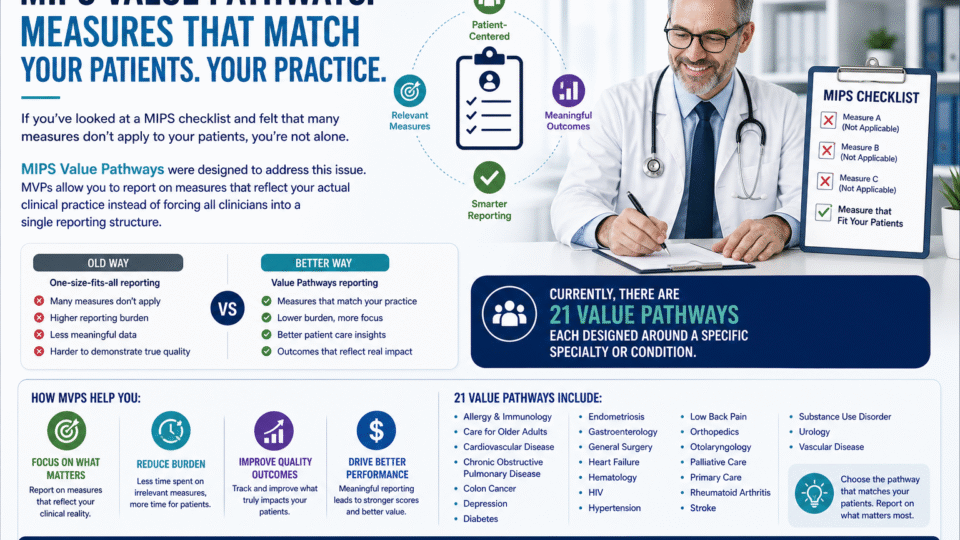
21 MVPs, One Practice: Choosing the Right MIPS Pathway
If you’ve looked at a MIPS checklist and felt that many measures don’t apply to your patients, you’re not alone. MIPS Value Pathways were designed to address this issue. MVPs allow you to report on measures that reflect your actual clinical practice instead of forcing all clinicians into a single reporting structure. Currently, there are 21 pathways available, each designed around a specific specialty or condition.
Choosing the wrong pathway can lower your score, waste time, and disconnect reporting from your actual clinical work. This is what separates providers who perform well in value-based care from those who struggle with reporting complexity.
What MIPS Value Pathways Actually Do
MIPS Value Pathways MVPs are designed to replace the general, one-size-fits-all MIPS framework with a more specific and clinically relevant approach. Providers no longer have to choose from hundreds of loosely related measures, but rather a curated set of measures related directly to their specialty or condition. Each MVP includes quality measures, cost data, and improvement activities, all linked to a single clinical focus.
Traditional MIPS vs. MVPs
| Features | Traditional MIPS | MVPs |
| Measure selection | Hundreds of options | Curated, specialty-specific |
| Relevance | Often mismatched | Directly tied to your practice |
| Data collection | Mostly manual | Claims-based automation |
| Performance story | Fragmented | Integrated and coherent |
Who Can Participate
MIPS reporting through MVPs is open to a range of entity types, not just solo practitioners or large systems.
Eligible participants include:
- Individuals reporting on their own performance
- Groups reporting as a single entity
- Virtual Groups, small practices joining together
- APM Entities already operating in Alternative Payment Models
- Subgroups enable MVP participation within multispecialty practices
That last point matters most for larger organizations. Subgroup reporting lets cardiologists report cardiology measures and orthopedic surgeons report orthopedic ones instead of everyone sharing the same mismatched list.
Choosing the Right MVP for Your Specialty
This is where most providers get stuck. The 21 available pathways include cardiology, oncology, orthopedics, rheumatology, neurology, behavioral health, primary care, and ophthalmology, among others. The goal is to choose what aligns best with your clinical practice, not what seems easiest.
Match Your Clinical Focus First
Start with what you treat most. If the majority of your patients have musculoskeletal conditions, the Musculoskeletal Care MVP is your natural fit. Don’t overthink it! The pathways are named and structured around clinical reality.
Review the Measure Set Honestly
Before committing, look at the measures inside the pathway:
- Are these outcomes you’re already tracking?
- Can you realistically influence these metrics?
- Are the data sources, claims, EHR, or registry, manageable for your team?
Check Your Data Infrastructure
MVPs rely on a combination of administrative claims, EHR, and registry data for cost and population health measures. This reduces manual submission, but only if your systems feed that data accurately. If your documentation practices are not aligned with MVP measure specifications, your scores may not accurately reflect your actual care quality.
Think About Your APM Direction
If you’re planning to move toward an Alternative Payment Model, pick an MVP that points that way. MIPS Value Pathways are intentionally designed as a bridge, making transitions to advanced APMs more natural over time.
Why Quality Drives Everything in MVPs
Quality is a central component of MIPS Value Pathways. Each pathway prioritizes outcome measures, high-priority indicators, and specialty-specific measures that directly reflect patient health outcomes.
When quality data is aligned with cost data and improvement activities, MIPS reporting becomes more meaningful and actionable. It becomes a tool for identifying care gaps and tracking measurable improvement.
Mistakes Worth Avoiding
- Picking measures based on ease rather than clinical fit
- Ignoring subgroup structure in multispecialty groups
- Underestimating data readiness before committing to a pathway
- Delaying participation and missing the learning curve advantage
Final Thoughts
With 21 options available, choosing the right MIPS Value Pathway depends on clinical alignment. Match your specialty, review the measures honestly, and think about where your practice is headed in value-based care. When implemented correctly, MVPs provide a structured framework that reflects the care you deliver.Persivia CareSpace® is a comprehensive digital health platform built to support MIPS reporting across every entity type, including the subgroups that make MVP participation possible. This platform covers all 21 MIPS Value Pathways, connecting quality measures, cost data, and improvement activities in one system so your reporting tells an accurate story about your practice, not just your paperwork.

Leave a Reply