


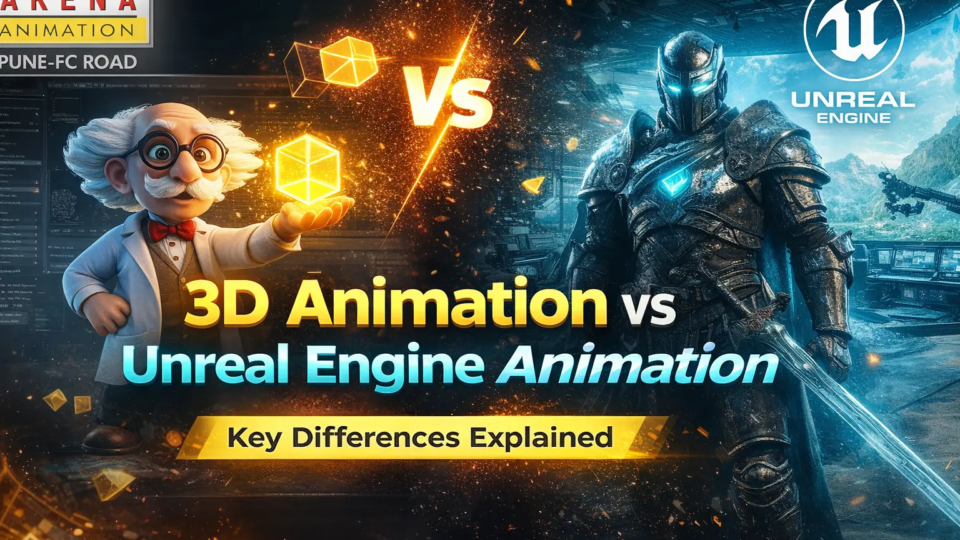
3D Animation vs Unreal Engine Animation: Key Differences Explained
The animation industry is in the middle of a significant shift. Real-time engines now power not just games but feature films, virtual production stages, and metaverse experiences — creating entirely new skill demands across studios worldwide. For anyone currently weighing 3D Animation Classes in Pune, understanding the difference between traditional 3D animation and Unreal Engine animation is no longer optional. It directly shapes the training path you take, the tools you master, and the roles you qualify for.
What is Traditional 3D Animation?
Traditional 3D animation follows a well-established linear pipeline: concept, modelling, rigging, keyframe animation, lighting, and finally, offline rendering. Software like Maya, Blender, and Cinema 4D anchor this workflow. Every finished frame is computed and rendered in advance — a process that can take minutes to hours per frame depending on scene complexity.
This method delivers exceptional visual quality with complete control over lighting simulation, material behaviour, and cinematic composition. It remains the dominant approach in feature films, television commercials, product visualisation, and pre-rendered VFX sequences. The trade-off is time — render queues are a real constraint in production environments working against tight deadlines.
What is Unreal Engine Animation and Real-Time Animation?
Unreal Engine, originally built as a game engine, has become a full-featured platform for real time animation across games, virtual production, and architectural visualisation. Its core tools — Sequencer for cinematic animation, MetaHuman for photorealistic character creation, and Live Link for motion capture streaming — give animators a powerful, integrated workflow.
The defining characteristic of real time animation is instant visual feedback. There are no render queues. As you animate, the scene renders continuously at playback speed, allowing immediate creative iteration. This dramatically compresses production timelines and has made Unreal Engine the platform of choice for live broadcast, LED volume stages, and interactive content.
Read Also : Arch Viz and Interior Design Course in Pune: 3D Visualization Career Guide
Unreal Engine vs 3D Animation: A Head-to-Head Comparison
When evaluating Unreal Engine vs 3d animation, the decision comes down to production context, career goals, and the type of output you’re targeting. Here’s how they compare across the factors that matter most:
| Factor | Traditional 3D Animation | Unreal Engine Animation |
| Render speed | Offline — hours per frame | Real-time — instant playback |
| Visual quality ceiling | Highest fidelity for film | Near-film quality, rapidly closing gap |
| Primary software | Maya, Blender, Cinema 4D | Unreal Engine 5 |
| Learning curve | Moderate — structured pipeline | Steeper — broader toolset |
| Primary industry use | Film, ads, VFX | Games, virtual production, metaverse |
| Hardware cost | Moderate — CPU-heavy rendering | Higher — requires strong GPU |
Use Cases: When to Use Traditional 3D vs Unreal Engine
Traditional 3D animation remains the industry standard for:
• Feature films and animated series where maximum visual fidelity is non-negotiable
• Television commercials requiring precise lighting simulation and photorealistic materials
• Product visualisation where every surface detail must be perfect
• Pre-rendered VFX sequences delivered as final compositing elements
Unreal Engine is the preferred platform for:
• Game development, where real-time performance is fundamental to the product
• Virtual production on LED volume stages, used across major film and broadcast studios
• Architectural walkthroughs where clients need interactive, live navigation
• Metaverse and XR content that demands dynamic, responsive environments
Most established studios use both pipelines. Traditional 3D handles the final beauty renders; Unreal Engine drives interactive previsualization, real-time VFX, and game content production simultaneously.
Career Impact: What Skills Do Employers Value More in 2025?
Unreal Engine expertise has become one of the most in-demand skills in gaming, virtual production, and broadcast animation. Studios running LED volume stages hire specifically for real time animation proficiency. Game companies now expect Unreal Engine fluency at entry level in several production roles.
Traditional 3D skills — rigging, keyframing in Maya, and offline rendering workflows — remain firmly dominant in animation studios and feature film pipelines. The strongest candidates in 2025 combine both, and 3D Animation Classes in Pune that incorporate Unreal Engine into the curriculum give graduates a genuine competitive advantage in a market where dual-skill professionals are actively sought.
What Should You Learn First: 3D Animation or Unreal Engine?
The logical sequence is: traditional 3D animation first, Unreal Engine second. The foundational skills — rigging, keyframing, understanding motion timing, and working with scene hierarchy — transfer directly into Unreal’s animation system. Without that base, Unreal Engine can become overwhelming quickly.
Starting with 3D Animation Classes in Pune that cover Maya or Blender builds the mental model you need. Once you understand animation principles at a structural level, Unreal Engine becomes a powerful layer on top — not a completely foreign system you’re learning from scratch.
3D Animation Classes in Pune: What to Expect from Training
Strong 3D Animation Classes in Pune cover far more than software tutorials. Expect structured exposure to industry-standard workflows: modelling and rigging fundamentals, character animation principles, rendering pipelines, and portfolio project development. The best programs now integrate Unreal Engine tracks alongside traditional 3D training, reflecting where the industry is headed.
Arena Animation FC Road offers programs built precisely around this dual-skill model. The 27-month Advanced Program in Animation with Unreal Engine and the 14-month Advanced Digital Graphics and Animation with Maya each combine foundational 3D training with tools studios actively hire for — giving students a production-ready portfolio before they graduate.
Read Also : Animation vs VFX vs Multimedia: Which Course Should You Choose?
FAQ: 3D Animation Classes in Pune
Q1: Can I learn Unreal Engine without knowing 3D animation?
You can begin Unreal Engine without prior 3D animation experience, but progress will be significantly slower. Understanding rigging, keyframing, and scene composition from traditional 3D training makes the Unreal Engine learning curve far more manageable and productive.
Q2: Is real time animation replacing traditional 3D?
Not replacing — extending. Real time animation is taking over games, virtual production, and interactive content, while traditional 3D holds its position firmly in film and high-end advertising. The industry needs professionals skilled in both pipelines, not one or the other.
Q3: How long does it take to learn Unreal Engine animation from scratch?
With a background in traditional 3D, most students reach a working proficiency level in Unreal Engine within 5 to 7 months. Dedicated programs like the Master in Unreal Engine track at quality 3D Animation Classes in Pune are structured specifically to deliver that progression efficiently. The Unreal Engine vs 3d animation learning curve is steeper when Unreal is your starting point, so foundational 3D training first makes a real difference.
Conclusion
Traditional 3D animation and Unreal Engine animation both carry strong futures — the right path depends on your target industry and career goals. If film and high-fidelity rendering is your aim, start with 3D fundamentals. If games and virtual production appeal, Unreal Engine proficiency is essential. For structured training that covers both disciplines, Arena Animation FC Road offers dedicated programs aligned with what studios are hiring for today.
Author: Bookmarkforu







Leave a Reply