


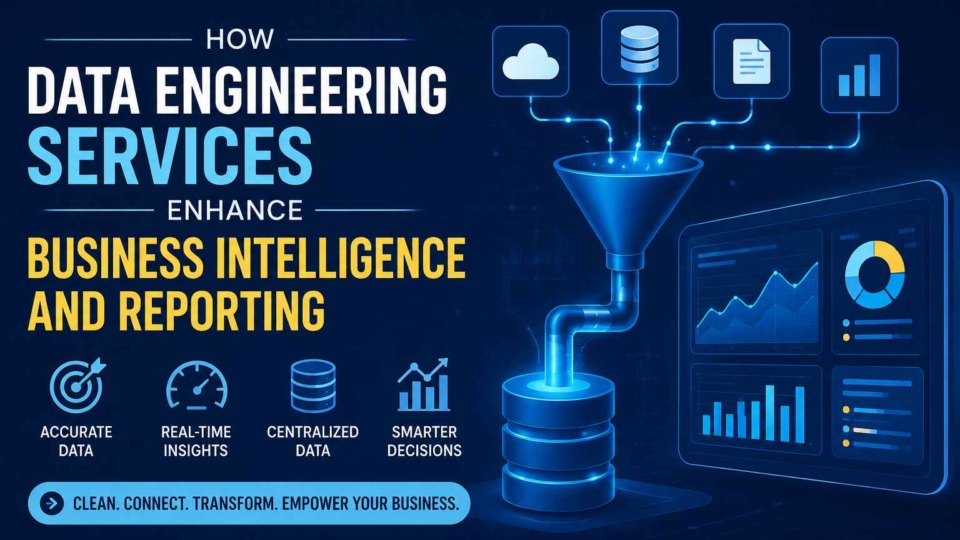
How Data Engineering Services Enhance BI & Reporting
In today’s fast-moving digital world, businesses generate huge volumes of data every day. From customer interactions and sales transactions to website analytics and operational records, data is constantly flowing through organizations. However, collecting data alone is not enough. Businesses need accurate, organized, and actionable information to make smart decisions. This is where data engineering services play a major role in improving business intelligence and reporting.
Business intelligence (BI) and reporting systems help organizations understand performance, identify trends, and make data-driven decisions. Without a strong data foundation, BI tools may produce inaccurate reports, delayed insights, or incomplete analysis. Data engineering ensures that raw data is transformed into reliable and meaningful information that supports better business outcomes.
Understanding the Role of Data Engineering
Data engineering involves designing, building, and managing systems that collect, process, and store data efficiently. It focuses on creating reliable data pipelines that move information from multiple sources into centralized platforms such as data warehouses or data lakes.
Modern businesses often use data from:
- CRM systems
- ERP software
- Websites and mobile apps
- Social media platforms
- Cloud applications
- IoT devices
- Financial systems
Handling such massive and diverse datasets manually can be difficult and time-consuming. Professional data engineering services help businesses automate these processes and ensure that data is always clean, consistent, and ready for analysis.
Improved Data Accuracy for Better Reporting
One of the biggest challenges organizations face is poor data quality. Inconsistent or duplicate data can lead to inaccurate reports and wrong business decisions. Data engineering solutions help standardize and validate information before it enters reporting systems.
For example, customer names may appear differently across multiple systems, or sales records may contain missing values. Data engineers build automated workflows that clean and organize this information. As a result, business intelligence tools can generate reports that are more accurate and trustworthy.
Reliable reporting enables decision-makers to:
- Monitor business performance effectively
- Identify growth opportunities
- Reduce operational risks
- Improve forecasting accuracy
- Enhance customer experiences
When businesses trust their data, they can confidently make strategic decisions.
Faster Access to Real-Time Insights
Modern organizations need real-time insights to stay competitive. Traditional reporting systems often rely on outdated or delayed data, which can slow down decision-making processes.
Advanced data engineering services enable real-time data integration and processing. This means businesses can monitor live dashboards and receive up-to-date reports instantly. Whether it is tracking sales performance, monitoring inventory levels, or analyzing customer behavior, real-time analytics gives organizations a significant advantage.
For example:
- E-commerce companies can track live purchase trends
- Financial institutions can detect fraudulent transactions quickly
- Logistics companies can monitor delivery performance in real time
- Healthcare organizations can analyze patient data faster
Timely information allows businesses to respond quickly to changing market conditions and customer demands.
Centralized Data Management
Many organizations struggle with data silos, where information is stored separately across departments. Marketing, finance, operations, and sales teams may all use different systems, making it difficult to create unified reports.
Data engineering solves this problem by centralizing information into a single platform. By integrating multiple data sources into one repository, businesses can achieve a complete view of their operations.
Centralized data management offers several benefits:
- Easier access to information
- Consistent reporting across departments
- Better collaboration between teams
- Reduced data duplication
- Improved data governance
Business intelligence tools become far more effective when they work with unified and structured datasets.
Enhanced Scalability for Growing Businesses
As companies grow, their data volume also increases rapidly. Traditional systems may struggle to handle large-scale data processing, leading to slower reports and system inefficiencies.
Modern data engineering architectures are designed for scalability. Cloud-based platforms and automated pipelines allow businesses to process massive amounts of information efficiently. This ensures that reporting systems continue to perform well even as data demands increase.
Scalable systems are especially important for businesses experiencing rapid digital transformation. Organizations can expand their operations without worrying about data bottlenecks or reporting delays.
Better Decision-Making Through Advanced Analytics
Business intelligence is no longer limited to simple charts and reports. Companies now rely on advanced analytics, predictive modeling, and AI-driven insights to gain a competitive edge.
Strong data engineering foundations support these advanced technologies by ensuring that data is accurate, accessible, and well-structured. Without proper data preparation, machine learning models and analytics tools may produce unreliable results.
With the help of well-implemented data systems, businesses can:
- Predict customer behavior
- Analyze market trends
- Optimize operational efficiency
- Improve product recommendations
- Forecast future sales
Organizations that leverage advanced analytics can make smarter decisions and improve overall business performance.
Increased Operational Efficiency
Manual data handling often consumes valuable time and resources. Employees may spend hours gathering information from different systems, correcting errors, and preparing reports.
Data engineering automates these repetitive tasks, reducing human effort and minimizing errors. Automated workflows ensure that reports are generated quickly and consistently.
Operational efficiency improves because:
- Teams spend less time managing data
- Reports are delivered faster
- Data errors are minimized
- IT workloads are reduced
- Employees can focus on strategic tasks
Automation not only saves time but also increases productivity across the organization.
Stronger Data Security and Compliance
Businesses must protect sensitive information and comply with industry regulations. Poorly managed data systems can expose organizations to security risks and compliance violations.
Professional data engineering frameworks include strong security measures such as:
- Data encryption
- Access controls
- Audit trails
- Backup systems
- Compliance monitoring
Secure data environments help businesses protect customer information and maintain regulatory compliance. This is especially important for industries such as healthcare, finance, and e-commerce.
Supporting Digital Transformation Initiatives
Digital transformation depends heavily on data-driven strategies. Businesses adopting cloud computing, artificial intelligence, and automation technologies require modern data infrastructures to succeed.
Data engineering creates the backbone for these initiatives by enabling smooth data integration, processing, and analysis. Companies can modernize their operations and improve innovation through the intelligent use of data.
Organizations that invest in strong data systems are better prepared for future technological advancements and changing business needs.
Conclusion
Business intelligence and reporting are only as effective as the data behind them. Without reliable data management systems, organizations may struggle with inaccurate reports, delayed insights, and inefficient decision-making. This is why investing in professional data engineering services is becoming increasingly important for modern businesses.
From improving data quality and enabling real-time analytics to supporting scalability and advanced reporting, data engineering helps organizations unlock the true value of their information. Businesses that build strong data foundations can gain deeper insights, improve operational efficiency, and make smarter strategic decisions in a competitive marketplace.
As technology continues to evolve, companies that prioritize data-driven operations will be better positioned for long-term growth and success.








Leave a Reply