


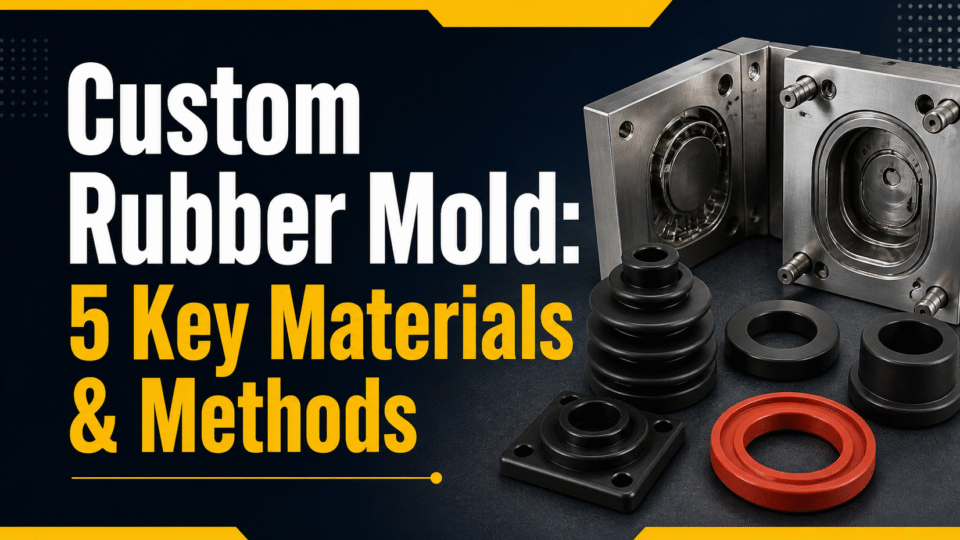
Custom Rubber Mold 5 Key Materials & Methods
Rubber parts don’t get much attention, but they’re everywhere in manufacturing. Think sealing car fluids or stopping heavy machines from shaking apart—it all comes down to getting it right. That’s where a custom rubber mold is essential. Skip the standard gaskets.
A mold made just for your needs lets you handle complex shapes or extreme hot temperatures. But picking the right rubber? That’s what requires a lot of knowledge. You also need the right way to shape it, and the actual work it has to do. Here are five key materials, methods, and big uses for rubber molded parts.
Before a single part is made, you must choose the right compound. Here are five common rubber molding materials used in a custom rubber mold.
1. Natural Rubber (NR)
Natural rubber is indeed tough, with great tensile strength, and is hard to tear. Perfect for high-impact applications. It soaks up shocks almost always, but oils and ozone? Not so much. When you pour NR into a custom rubber mold, the result is flexible bushings and mounts that simply work.
2. Silicone Rubber
If temperature extremes exist, silicone is the answer.
Silicone Rubber stays stable from -65°F all the way up to 500°F. That’s why a custom rubber mold for silicone shows up everywhere in medical gear and food-safe seals. Silicone won’t react with anything, plus it’s non-toxic.
3. EPDM (Ethylene Propylene Diene Monomer)
EPDM is the champion of weather resistance.
This rubber can handle UV, water, and steam. So when you need outdoor seals or car weatherstripping, a custom rubber mould using EPDM is the smart move. It lasts for years without cracking or falling apart on you.
4. Nitrile Rubber (NBR)
When petroleum-based fluids are present, NBR is the standard. It resists swelling in contact with gasoline, oil, and diesel. A custom rubber mould designed for fuel system components almost always specifies NBR for its low compression set.
5. Fluorocarbon (Viton)
For aggressive chemicals and high heat (up to 400°F+), fluorocarbon is the premium choice. A custom rubber mould used in aerospace or chemical processing leverages Viton’s unmatched resistance, although it comes at a higher cost.
Manufacturing Methods for Custom Rubber Moulding
Once the material is chosen, the next step is forming it. So how does raw rubber turn into something useful? That’s called custom rubber moulding. There are four main ways to do it. Each one brings something different to the table.
1. Compression Molding
This is the oldest and simplest way to mold rubber—and it still gets the work done. A measured chunk of rubber, called a preform, is placed into an open mold. Once the mold closes, heat and pressure come in, pushing the material to fill every corner.
If you’re making larger parts, thicker sections, or low volumes, this is the preferred choice. Tooling costs are lower too—much more affordable than other methods.
2. Transfer Molding
A hybrid of compression and injection, transfer molding uses a pot and plunger.
Instead of just squishing, transfer molding forces rubber from a pot through a gate and into the cavity. Result? You can get more complex geometries, and tighter dimensional control is achieved. For intricate inserts or rubber bonded to metal, this custom rubber moulding method is the top pick.
3. Injection Molding
Need a ton of parts fast? Injection molding is the choice. Rubber gets heated, then a screw injects it into a closed mold under high pressure. This gives you the fastest cycles and the tightest tolerances. When a rubber mold manufacturer invests in injection presses, they can generate thousands of identical parts every day with almost no flash.
4. Liquid Silicone Rubber (LSR) Molding
A specialized subset of injection molding, LSR uses two liquid components that mix just before injection. The platinum-cured material sets rapidly. Custom rubber moulding with LSR is ideal for micro-parts, baby bottle nipples, and LED lenses due to its clarity and purity. No other method achieves such fine detail with silicone.
Major Industrial Applications of Rubber Molded Parts
All the materials and methods converge in real-world use. The industrial applications of rubber molded parts are nearly endless, but three sectors dominate demand.
Automotive & Transportation
Modern vehicles contain hundreds of rubber components. From engine mounts soaking up shakes to O-rings keeping fluids inside—the need is massive. Industrial applications of rubber molded parts here cover suspension bushings, exhaust hangers, and even fuel injector seals. A single failure here can lead to catastrophic engine damage.
Aerospace & Defense
Reliability is non-negotiable at 35,000 feet. Rubber parts here face rapid pressure changes, jet fuel, and hydraulic fluids. The industrial applications of rubber molded parts in aircraft include door seals, gaskets for fuel tanks, and vibration-damping pads for avionics. Only certified materials and validated custom rubber moulding processes meet FAA standards.
Medical & Pharmaceutical
In surgical tools and drug delivery systems, cleanliness is king. Silicone parts dominate this space. The industrial applications of rubber molded parts here are highly specific: syringe gaskets, peristaltic pump tubing, and respirator mask seals. Every custom rubber mould used in medical settings must be produced in a cleanroom to prevent contamination.
Heavy Construction & Mining
In construction and mining, nothing is easy. There is constant impact and constant abrasion. Custom rubber molding makes durable parts like track pads, hydraulic seals, and screening panels using extra-tough compounds. Get a good custom rubber mould, and those components will handle heavy loads, slow down wear, and avoid expensive downtime when conditions are harsh.
How to Choose the Right Rubber Mold Manufacturer
Given the complexity of materials (silicone, EPDM, NBR) and methods (compression, transfer, injection), selecting the wrong partner is risky. A reputable rubber mold manufacturer will offer design for manufacturability (DFM) feedback. They will analyze your 3D drawing and recommend whether compression or LSR is cheaper.
You’ll get advice on draft angles and parting lines, too. And a good rubber mold manufacturer keeps tight quality controls—tensile testing, durometer hardness checks, the works. So don’t chase the lowest price. Ask to see case studies from your field. A company with aerospace experience will treat fluorocarbons way differently than a consumer-items manufacturer. The right rubber mold manufacturer acts like a partner, not just a supplier.
Conclusion:
Raw polymer turns into a reliable part, and it’s all about precision. We looked at five rubber molding materials—from natural rubber to fluorocarbon—each made for different applications. We walked through a few custom rubber moulding methods, each balancing speed, cost, and complexity. And we checked out industrial applications of rubber molded parts.
Need one prototype or a million parts? It always starts the same way: a custom rubber mold. By sourcing that tool from an experienced rubber mold manufacturer, you ensure that your final part will withstand pressure, temperature, and time.
CTA
When you need precision-engineered rubber solutions for industrial use, having the right partner changes everything. KRISHANI delivers advanced molding capabilities aimed at performance-focused applications across multiple industries. For questions, project chats, or help, reach out at +1(647) 294-5240 or info@krishani.com.

Leave a Reply