


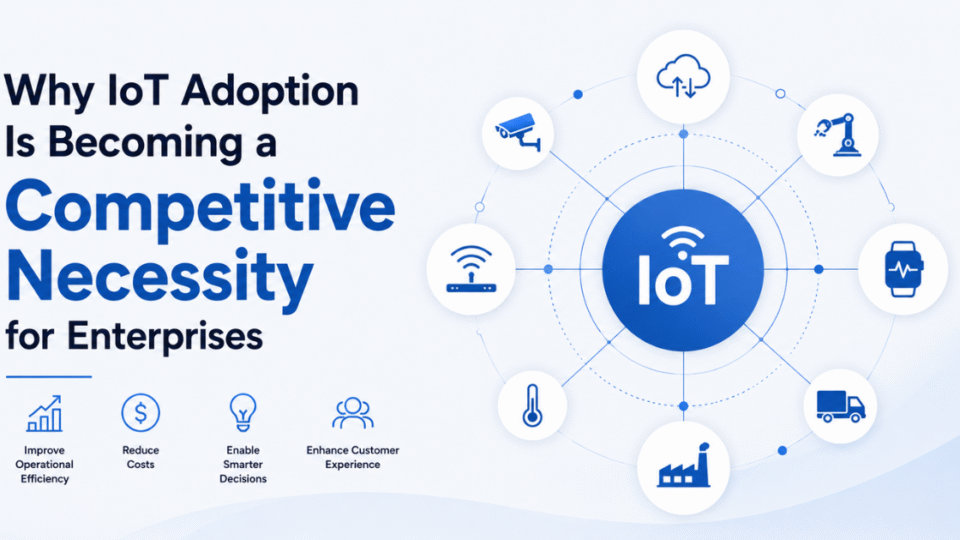
Why IoT Adoption Matters for Enterprises
Enterprises are no longer evaluating IoT as an experimental technology. They now treat it as a core infrastructure layer that connects operations, assets, and decision-making systems in real time. The shift has accelerated because operational environments have become more data-intensive, distributed, and time-sensitive than traditional IT systems were designed to handle.
Industry data supports this change. According to Statista, the number of connected IoT devices is expected to exceed 29 billion by 2030, compared to about 15.9 billion in 2023. Gartner also reported that enterprise IoT spending crossed $805 billion globally in 2024, reflecting strong investment in connected operations and industrial monitoring systems. In addition, McKinsey estimates that IoT applications in industrial environments alone could generate up to $1.2 trillion annually by improving operational efficiency and reducing downtime across sectors such as manufacturing, logistics, and energy.
These numbers point to a clear direction: IoT adoption is no longer optional for enterprises that depend on physical infrastructure, distributed assets, or real-time operational control.
The question has shifted from “Should we adopt IoT?” to “What happens if we do not?”
Why Enterprises Are Moving Toward IoT-Driven Operations
Most enterprises adopt IoT after encountering operational blind spots. Traditional systems often rely on periodic reporting rather than continuous visibility. Machines, vehicles, and industrial assets generate data continuously, but without IoT systems, that data remains unused or delayed.
This delay creates measurable business problems, such as:
- unplanned equipment failures
- inefficient asset utilization
- delayed maintenance response
- inaccurate demand forecasting
- energy waste in large facilities
In industries like manufacturing or logistics, even short periods of downtime can cause financial loss that multiplies across supply chains. IoT addresses this gap by converting physical activity into real-time digital signals.
However, the value of IoT does not come from data collection alone. It comes from how enterprises act on that data across systems, teams, and operational workflows.
Real-Time Visibility Becomes a Baseline Requirement
Before IoT adoption, many enterprises depended on scheduled reporting cycles. Equipment performance reports might arrive daily, weekly, or monthly. That model works in stable environments but fails when operations require immediate response.
IoT changes this model by enabling continuous monitoring of assets.
Sensors installed across machines, vehicles, or infrastructure continuously transmit operational data such as:
- temperature fluctuations
- vibration levels
- energy consumption
- load performance
- environmental conditions
This allows enterprises to identify anomalies as they occur rather than after failures happen.
For example, in manufacturing environments, a slight increase in machine vibration may indicate bearing wear. Without IoT, this signal may go unnoticed until a breakdown occurs. With IoT, maintenance teams can respond before disruption spreads across production lines.
The shift from reactive reporting to real-time visibility is one of the most important operational changes enterprises experience after IoT adoption.
Predictive Maintenance Changes Asset Lifecycle Management
One of the strongest use cases for IoT in enterprises is predictive maintenance.
Traditional maintenance models operate on fixed schedules. Machines receive service at predefined intervals regardless of actual condition. While simple, this approach often leads to two inefficiencies:
- Unnecessary maintenance on healthy equipment
- Unexpected breakdowns between service cycles
IoT introduces condition-based maintenance by continuously analyzing asset performance.
When integrated with analytics systems, IoT data helps predict:
- Component wear and failure probability
- Optimal service intervals
- Performance degradation patterns
- Operational stress levels
This improves asset lifecycle management significantly.
Instead of reacting to failures, maintenance teams can plan interventions based on actual equipment behavior.
Operational Efficiency Improves Across Distributed Systems
Enterprises with geographically distributed operations benefit significantly from IoT adoption.
Industries such as logistics, energy distribution, mining, and agriculture rely on assets spread across large physical areas. Without IoT, monitoring these systems requires manual inspection or delayed reporting.
IoT enables centralized operational control through connected devices.
For instance:
- Logistics companies track fleet movement and fuel consumption
- Energy providers monitor grid performance and fault conditions
- Agriculture operations analyze soil moisture and irrigation patterns
- Mining companies track equipment utilization in remote environments
This level of visibility reduces inefficiencies caused by guesswork or delayed decision-making.
The operational improvement does not come from automation alone. It comes from better timing of decisions based on real-world conditions.
IoT Expands Revenue Models Beyond Core Operations
IoT adoption not only improves efficiency. It also creates new revenue opportunities.
Many enterprises now shift from product-based models to service-based or data-driven models.
For example:
- Equipment manufacturers offer predictive maintenance subscriptions
- Automotive companies provide usage-based insurance models
- Industrial vendors offer performance-based service contracts
- Smart building providers charge based on energy optimization outcomes
In these models, IoT data becomes the foundation of recurring revenue.
Instead of selling a machine once, enterprises continue generating revenue through its lifecycle based on performance data. This shift explains why IoT has become strategically important in competitive industries.
Real-World Enterprise Example: Rolls-Royce Aviation Monitoring
Rolls-Royce provides one of the most widely referenced enterprise examples of IoT adoption in aviation.
The company uses IoT sensors embedded in aircraft engines to monitor performance in real time. These sensors collect data related to:
- Engine temperature
- Fuel efficiency
- Pressure levels
- Vibration patterns
- Operational stress conditions
This data is transmitted back to monitoring centers, where engineers analyze engine health continuously.
Before IoT adoption, maintenance decisions were based on scheduled inspections. After IoT integration, maintenance became condition-based and predictive.
The operational impact includes:
- Reduced unplanned engine downtime
- Improved fuel efficiency monitoring
- Better maintenance scheduling accuracy
- Extended engine lifecycle management
This example highlights a key point: IoT adoption does not just improve technical visibility. It changes how entire service models operate in high-value industries.
Why Integration Matters More Than Device Deployment
Many enterprises initially assume IoT success depends on installing sensors and collecting data. In reality, device deployment is only the starting point.
The real value comes from integrating IoT data into enterprise systems, such as:
- ERP platforms
- Supply chain management systems
- Analytics platforms
- Asset management tools
- Customer-facing applications
Without integration, IoT data remains isolated and underutilized.
For example, a manufacturing plant may detect machine failure risk through sensors. But unless that data connects to procurement systems, maintenance workflows, and production planning tools, operational response remains slow.
This is where architectural design becomes critical.
Enterprises often rely on an experienced IoT Development company to design scalable data pipelines, device communication frameworks, and system integrations that connect operational layers effectively.
IoT in Industrial Environments and IoT-Driven Automation
Industrial IoT adoption is accelerating faster than consumer IoT because the return on investment is more direct.
Factories, warehouses, and production facilities use IoT to monitor:
- Machine uptime
- Production throughput
- Energy consumption
- Safety compliance
- Environmental conditions
When combined with automation systems, IoT enables semi-autonomous operational environments where systems adjust based on real-time conditions.
For instance, a smart factory may automatically adjust machine speed based on temperature or load conditions to prevent overheating and reduce wear. This reduces human intervention in routine operational adjustments and improves consistency.
Role of IoT Development Services in Scaling Enterprise Systems
As IoT deployments grow, enterprises face new challenges:
- Managing large-scale device networks
- Ensuring secure data transmission
- Handling high-volume data streams
- Maintaining system reliability
- Updating firmware and device logic
These challenges require structured engineering support.
This is where IoT Development Services become important. These services focus on building scalable architectures, managing device ecosystems, and ensuring secure communication between hardware and enterprise software layers.
Without structured development support, IoT systems often face issues such as data fragmentation, security vulnerabilities, and integration failures.
ROI and Business Impact of IoT Adoption
IoT adoption creates measurable financial and operational improvements across industries.
Common enterprise-level outcomes include:
- Reduced unplanned downtime in industrial equipment
- improved asset utilization rates
- lower maintenance costs through predictive servicing
- Reduced energy consumption in large facilities
- improved supply chain efficiency
- increased service-based revenue opportunities
Even small improvements in uptime can have a significant financial impact in capital-intensive industries.
For example, reducing machine downtime by just a few percentage points in manufacturing environments can lead to substantial annual cost savings due to increased production availability. Similarly, logistics companies often see improved fuel efficiency and route optimization, which directly reduces operational expenses.
Challenges Enterprises Face During IoT Adoption
Despite its benefits, IoT adoption is not without challenges.
Enterprises commonly face:
- Security risks in connected environments
- Lack of standardization across devices
- Integration complexity with legacy systems
- Data overload without proper analytics
- Skill gaps in IoT engineering and architecture
These challenges often slow down large-scale deployment unless addressed early in the design phase. Successful implementations focus not only on technology but also on governance, scalability, and operational alignment.
Final Thoughts
IoT adoption has moved beyond innovation experiments and into core enterprise strategy. Businesses are adopting connected systems not because they want more data, but because they need real-time control over increasingly complex physical operations. From predictive maintenance to operational visibility and new revenue models, IoT directly influences how enterprises compete in modern markets. However, success depends on more than device installation. It requires strong architecture, integration planning, and long-term system management.
An experienced IoT Development company plays a key role in designing scalable and secure ecosystems, while IoT Development Services ensure those systems remain reliable as data volumes, devices, and operational demands grow. Enterprises that adopt IoT strategically are not just improving efficiency—they are reshaping how their entire operational and business models function in a connected economy.

Leave a Reply